molotovs on glass beach
The illness started a month ago. An increased gravity pulled down on my limbs. I looked longingly at sinus trephination diagrams. I discovered that the one ingredient that makes cold medicine expensive, phenylephrine, is no more effective than a placebo. And though the fog has lifted from my brain, a clawing cough remains, placated by either salt-water gargles, spoons of honey or the whims of the demiurge.
This is all to say that I was in the perfect state to play a Pokémon ROM hack.
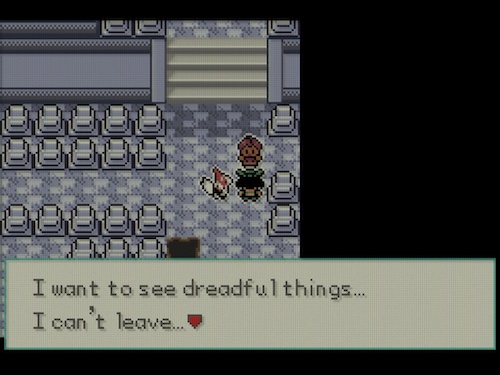
Emerald Seaglass is a modified version of Pokémon Emerald for the Gameboy Advance, part of the third generation of Pokémon. Though post-Pokémania and my introduction to the series with generation two's Pokémon Gold on GameBoy Color; Ruby, Sapphire and Emerald are a nostalgic flashpoint, being games that my then jet-setting uncle got me early from America, and also being the last non-remake Pokémon games I loved. Seaglass is a particularly lethal dose of nostalgia due to its primary gimmick- emulating the look of generation two, which includes translating 447 Pokémon into Gameboy Color style sprites, while retaining the snappiness of the Emerald engine and the GBA's wider 3:2 aspect ratio. Were I in the business of consumer advice, I'd give the game a positive review- after all, Emerald was already a good game, refining Ruby and Sapphire by utilising both of their respective villain teams, and Seaglass retains all of its post-game goodies. It's remarkable that only the cycling road had to sacrificed in the translation to the new-old style, and given that it adds many other activities in its place (the scuba safari is a particular highlight) and is entirely free (providing you legally rip your legally owned Pokémon Emerald cartridge, naturally), it is hard to complain about.
Let's try anyway- because nostalgia aside, this is a deeply weird game, one full of aesthetic contradictions and kludged together "quality of life improvements" that chip away at what was good about Game Freak's design, leaving us with a hyperreality of convenience and a monument to arrested development. If that all sounds really mean, that's because it is, but given my Maladies I've had little else to think about. None of what I'm about to say should take away from Nemo622's efforts, since a lot of the implementation here makes a lot more sense when viewed as project based learning for their even more ambitious Pokémon Lazarus. Rather, I worry that with the prominence of these hacks (and the not even vaguely commendable vibe-coded slop versions), they are becoming the de facto way a modern user approaches these older games, and that they offer a parallel world where art becomes a have-it-your-way fast food experience where no one ever has to grow up.
First, we must address the elephant in the room- why do these ROM hacks exist? Including spin-offs, there are almost a hundred Pokémon video games, with nine generations of the core RPGs. Surely this is enough for even the most rabid fan to contend themselves with, as even the original games with a mere 151 creatures to catch will take almost a hundred hours to fully complete. Ah, a somehow even larger elephant in the room- though Scarlet and Violet were Nintendo's biggest game launch of all time, the fanbase remains divided by dimensions, with large numbers preferring the pixel art abstraction of the first five generations. A huge component of this is nostalgia- your favourite Pokémon game is almost certainly the first one you played, but there's more to it. Even if the modern games were afforded as much time and money required to convincingly deliver a fantasy ecology of super-powered monsters, cutting to a random encounter in tall grass is far more efficient in selling the illusion.
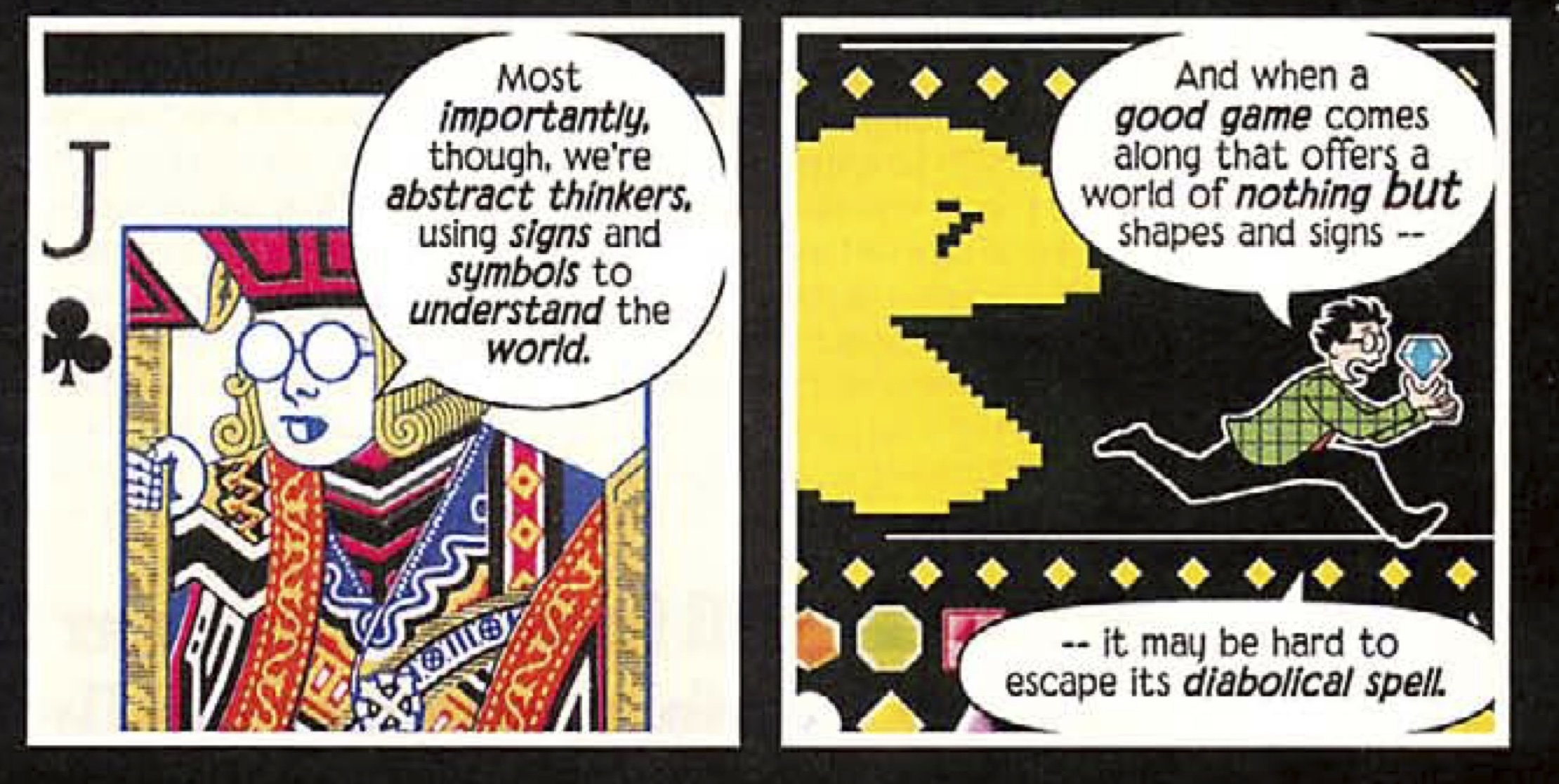
This transition functions similarly to the gutter in comic books. As Scott McCloud describes in Understanding Comics, that medium relies upon the reader to "fill in the gaps between panels as an animator might", but in an RPG battle transition it is not merely a matter of us imagining The Thing extending a punch before an impact panel. Instead, when we find a random encounter in the tall grass, we shift into an entirely different perspective, with large creature sprites and a debatably first person or at least third person over the shoulder view. We are asked to imagine that this is what our player character is seeing the whole time. We meet the developer halfway and believe that we would see it too, were we not at a top-down remove.

In Pokémon there's even more abstraction going on, more bargaining of our imagination. Fighting is presented to us as turn-based, but this is a concession of the medium, an opportunity for strategic play. There's no mention in game that trainers take turns, and even if they did it's unlikely a wild animal would limit themselves to fair play. The moves themselves are in the realm of the conceptual, as the generations go by the animations may get more detailed (or less, debatably), but we're still asked to imagine there's a difference between the healing moves Roost, Recover, Soft-Boiled and Slack-Off, despite being functionally identical. Moreover the backgrounds are further abstractions, if present at all, depicting pixel forests or deserts or seas that necessarily repeat across multiple locations. The classic Pokémon games rely upon what McCloud refers to as "closure", our minds desire to fill in the gaps, with greater abstraction requiring more of our imagination. With this in mind it's not hard to understand how the 2D games have a greater hold on those that grew up with them, and how they may even cast the same spell on the younger generation.
If you're screaming at me that this applies to Final Fantasy, Shin Megami Tensei, Bodycon Quest and an inordinate number of other RPGs, J or otherwise, then yes, you've identified the off-ramp. Pokémon is a young person's game, and if you wanted another game in its style you have plenty of grander, darker or even hornier places to go. Or indeed, if you feel that's enough, then it almost certainly is, and you can become one of those normal people I hear so much about. ROM hacks kick that ramp away and suggest that no, you don't want any of that stuff, because we can put that stuff in Pokémon. Old games are new again. New games are old again. It never has to end. If you enter this parallel world you'll find theres a new hundred hour passion project with follower Pokémon and hard-modes and a new original region/revamp of an old one with all the mons you could ever want every month or so.
The passion is extraordinary, and from a developer perspective I can see the appeal. You get a strong framework with excellent tools and a community that has broken these games into the smallest constituent parts and may know more about them than Game Freak. You also get a cottage industry of YouTubers who will hype your game, review it, and record commentated runs of it with ever more gnarly self-imposed challenges. You even get influencers who will photograph the title screen of your game and mysteriously never comment on it again. Unlike with other fan games, Nintendo has long since given up on smacking them down, presumably not just because of their quantity but also because they are niche enough to not be serious competition to the staggering sales numbers of the mainline games, and if anything constitute free marketing for the cute little guys, so why not give it a go? It's on the player end that we have searching questions to ask, since unless you're in the frankly bizarre situation of playing these for your livelihood, why play these?
Seaglass includes a lot of concessions that may or may not matter to the type of person who plays these games. The typings and the way they work reflects the more modern games, including the Physical/Special split. Every mon in the Pokédex can be caught in game. Nowhere is safe from your running shoes. That's before we get into the dozens of opt-ins, tweaks and features that can be set in menus or by new items. The DexNav from the Ruby and Sapphire remakes is here, along with optional charms that make finding the super-rare shiny mons a great deal easier. A modern-styled ExpShare that divvies earned experience across your entire party ensures no mon is left behind. I'm not a huge fan of that, since I think it shifts the player from maintaining a relatively consistent team that covers all bases to constantly shuffling in new members to maximise levelling potential, but this is a by now quite old Game Freak addition.
The one that infuriated me enough to write this is the Pokémon Box Link, an item that lets you access your Pokémon storage anywhere. This I gather is present in the newer mainline games, though I refuse to believe it could be as egregious as its implementation here. Not only can you swap out fainted for healthy mons anywhere on the field, you can do it dungeons, including the gruelling Victory Road and yes, even in the Pokémon league. Pokémon, in its vanilla form, is never very difficult, with even its meaner games susceptible to brute force and ignorance. But they are punishing- whether its in a labyrinthine cave or a trainer gauntlet, failure offers you two possibilities: you made a tactical error, or more often than not, you were not prepared, in levels or items or team composition. This friction is what helps us build attachment to our six little guys, and is the primary motivation for the development of the Nuzlocke challenge runs. Freely swapping out allows you to be unprepared and disengaged, to treat every Pokémon you catch as gristle for the optimal completion machine. This is optional, much like the bizarrely one-sided Z-Moves you can opt into, but optional isn't really optional. These are not accessibility toggles, these are in-game mechanics.
Soren Johnson, lead designer on all time banger Civilization IV, said as much in his Game Developer magazine column:
"Many players cannot help approaching a game as an optimization puzzle. What gives the most reward for the least risk? What strategy provides the highest chance – or even a guaranteed chance – of success? Given the opportunity, players will optimize the fun out of a game."
There's no reason for me to pick on Emerald Seaglass for this beyond me actually having finished it, the others I've flirted with have many of the same suite of quality of life improvements, regardless if they actually improve things or not. I can't help but feel that these are just massagers for boredom, the same as the insidious autoplay on every online video platform, a way to mindlessly keep going, a pillow pressed down on your brain. Games, video and otherwise, are paradoxical in that though we do them for leisure or camaraderie, they by necessity irritate and bore, because learning things is hard, focus is difficult and failure isn't optional. And yet we play. But playing isn't optimal, it doesn't fit into any Protestant work ethic. My friend Oma has been sharing sections of a book I really should read, Brian Sutton-Smith's The Ambiguity of Play, and this snippet really caught my attention.
"In her preschool child studies, for many years Greta Fein has maintained that more attention should be paid to these affective issues rather than to the reigning cognitive focus (Fein and Kinney, 1994). In a note to me, she writes: "I do not think play is about cognition and I don't think playing makes kids especially smarter. It most likely makes them happier... Little kids who do not play are usually very unhappy."
So what to make of optimised play, play fast-forwarded, play that never ends but also never excites? I don't think it makes us happy. It certainly doesn't make me happy. But it certainly takes up time, and that can be a balm. I don't think rogue-lites and incremental games would be so popular in a world not so atomised, I don't think games over hundreds of hours of minimally different content would be viewed as valuable were the average human not priced out of basic necessities, I don't think nostalgia would be so intoxicating were the future not closed off and I don't think play will be this anodyne in the better worlds to come.
Emerald Seaglass shares commonality with broader trends in popular culture, it is a symptom, not a cause, but what about that name? Sea glass was almost certainly chosen because of the infamously huge amounts of water in Generation 3, as in real life it is found on beaches. The sea acts as a giant rock tumbler, polishing over years and years, removing all rough edges. In Fort Bragg, there is a beach covered with these pieces of glass, and it looks quite pretty. It's now known as glass beach, but it used to be called "The Dumps", a landfill for the Union Lumber Company. So huge were the landfills that Molotov cocktails were used to set fire to the piles.
After all, sea glass is made from garbage.